
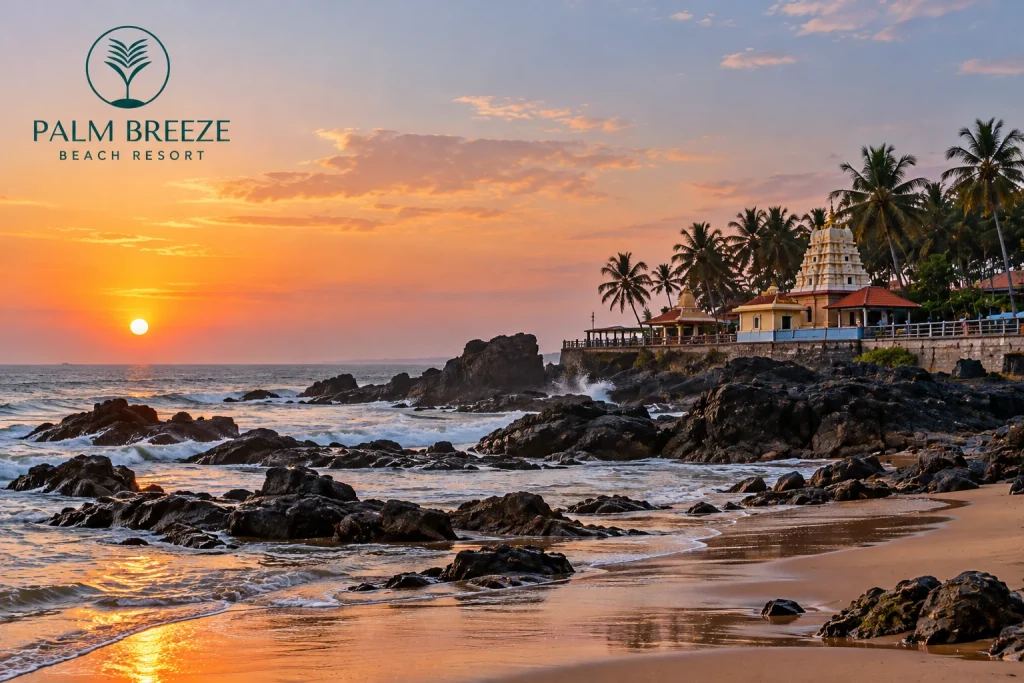
Someshwara Beach, about 10 to 13 km south of Mangalore city, is the one on this coast that doesn’t look like the others. Instead of an open sweep of sand there’s a cluster of black rocks sitting in the surf, a Shiva temple on the shore above them, and waves that break hard enough to explain why nobody swims here.
It’s a photographer’s beach and a temple beach rather than a swimming one, and this guide covers it honestly: the rocks and what they’re called, the temple and its timings, the dargah at Ullal, how to get there, and why the water is genuinely dangerous.
One quick clarification first. This is the Someshwara Beach at Ullal, in Mangaluru taluk, Dakshina Kannada. There’s another beach of the same name at Byndoor, in Kundapura taluk, Udupi district, roughly 120 km north near Maravanthe. Several guides mix the two up. If you want the Byndoor one, you’re in the wrong article.
Key takeaways: Someshwara is roughly 10 to 13 km south of Mangalore city centre, named after the Shree Somanatha temple on its shore. The black rock cluster at the waterline is called Rudra Paadhe, meaning Shiva’s rock in Tulu, and it’s most visible at low tide. Karnataka Tourism advises against swimming here because of strong currents, drownings are repeatedly reported, and sea entry is prohibited through the monsoon by district order. Late afternoon at low tide is the time to come. There is no surf operation here; for that, Mulki is 30 km north.
| Location | Ullal, Mangaluru taluk, Dakshina Kannada, about 10 to 13 km south of the city centre |
| Known for | The Rudra Paadhe rock formations, the Somanatha temple, sunsets |
| Entry fee | None |
| Swimming | Not advised by Karnataka Tourism; prohibited through the monsoon |
| Best time of day | Late afternoon, ideally at low tide; early morning is the other good window |
| Shade | Almost none, carry water |
| Nearby | Sayyid Madani Dargah, Ullal; the Netravati-Gurupura estuary |
| Nearest beach resort | Palm Breeze Beach Resort, Mukka, about 35 km north |
South of the city, past Thokkottu, at Ullal. On the distance, we’re going to be straight with you rather than confident: published figures range from 9 km to 19 km, and no authority settles it. The best-supported single figure is 13 km south of Mangalore, so plan on 10 to 13 km and roughly 25 to 35 minutes by road. Karnataka Tourism’s own page says “approx. 5 km”, which is an outlier well below every other source and sits in a malformed sentence, so we’re not using it.
The black rock cluster at the water’s edge is called Rudra Paadhe, also written Rudra Shile. Rudra refers to Shiva and paadhe or shile means rock in Tulu, so the name translates roughly as Shiva’s rock. The temple site is known as Rudrapada Kshetra for the same reason.
Local tradition holds that this is where the sage Sukadeva meditated. Whatever you make of that, the rocks are the reason to come: dark, angular, sitting right where the waves break, and they photograph like nothing else on this coast.
The one piece of timing advice that matters here: the rock cluster is most visible at low tide. At high tide much of it is under water and you’ve driven out for a fairly ordinary beach. Check a tide table before you go, and aim for low tide in the late afternoon if you can get both.
One thing to hold in mind while you’re framing the shot: Rudrapada Kshetra is where Mangaloreans come to perform the last rites for their dead. Some of the people around you are here for that, not for the view. Keep your distance from any ritual in progress, and don’t photograph it.
The beach is named after the Shree Somanatha Temple on its shore, dedicated to Shiva in the form of Somanatha. The site, Rudrapada Kshetra, is also a pilgrimage place for pitrakriyas, the last rites performed for departed souls, which gives the temple a quieter and more solemn character than its setting suggests.
Darshan timings are roughly 6 am to 1 pm and 5 pm to 8 pm, with the Mahapooja at noon and a midday closure in between. Sources disagree on the exact evening slot, with one giving 4 pm to 8:30 pm, so if the evening visit is the point of your trip, confirm locally.
On its age: the temple is historically attributed to the Alupa dynasty around the 10th century AD, later administered by the Kadambas of Banavasi and the Choula rulers of Ullala, and renovated in the 15th century under the Vijayanagara king Immadi Devaraya, according to inscriptions recorded by local heritage sources. Devotional tradition credits its founding to King Kharasura, a relative of Ravana. We’re flagging which is which rather than blending them.
The temple is also associated with Rani Abbakka of Ullal, the 16th-century queen remembered for resisting the Portuguese. A fort attributed to her stands near the temple, and she is said to have been a devotee who donated a jaladhani, a water vessel, still used during the Jathra. Some accounts credit her with building the temple outright, which doesn’t square with the 10th-century attribution, so treat that as devotional memory rather than record.
The main annual festival is a seven-day Jathra Mahotsava, during which the temple stays open day and night. There’s also a Laksha Deepotsava in Tula masa, roughly mid-October to mid-November, and Maha Shivaratri. No source we could find states which month the Jathra falls in, so ask at the temple rather than trusting a date you read online. Our guide to the famous temples in Mangalore covers the bigger temple circuit in the district.
No, and this is the most important section on this page.
Karnataka Tourism, the state’s own tourism body, states that the sea here is rough because of strong currents near the Rudra Shile and that swimming is generally not advised, describing the beach as one that attracts photographers more than swimmers. Hidden rocks compound the problem. The thing that makes this beach beautiful is the thing that makes it dangerous.
Drownings here are not hypothetical. Local media have reported deaths at this beach repeatedly, including a man swimming during a family outing and a group of young men caught by a large wave at the rocks. We haven’t been able to date those reports, so we’re not giving dates, but the pattern is well established.
During the monsoon it’s not a judgement call, it’s prohibited. In June 2026 the Dakshina Kannada district administration suspended all water sports at Someshwara, Panambur and Tannirbhavi and prohibited sea entry until further notice, with warning signboards and penalties for violators, as reported by Mangalore Today and The Hans India.
Where this stands: that order was issued in June 2026 and reported as running until the monsoon ended, which the district administration put at three to four months. Orders like it are re-issued every monsoon, so treat June to September as closed by default and check the district administration’s current notice for any other month.
One more thing worth knowing, and no other guide mentions it: Someshwara does not get the same lifeguard cover as the beaches north of the city. A May 2025 report described 19 lifeguards deployed across the redeveloped Tannirbhavi stretch known locally as the Blue Flag beach, Panambur, Tannirbhavi main and Sasihithlu, with Someshwara and Ullal instead getting “Pravasi Mitra” tourist guards and signage urging visitors not to go deep. Come here to look at the sea, not to get into it.
A short distance from the beach is the Sayyid Madani Dargah, the shrine of Khuthbuz Zamaan Hazrat Sayyid Muhammad Shareeful Madani Thangal, a Sufi saint from Madinah. It’s one of the most significant shrines on this coast and is visited by people of different faiths seeking blessings, which is the detail most worth knowing about it.
The dargah’s Urs is held once every five years, not annually, which catches visitors out. The 22nd quinquennial Uroos began on 25 April 2025 and was described as running for about a month, with nightly sermons by Ulama scholars. On that five-year cadence the next edition is due around 2030. Dates for the saint’s arrival from Medina vary across sources between the 16th century and “roughly 400 to 500 years ago”, so we’re not picking one.
No. There’s no surf school, surf club or organised watersport base at either beach, and the rocks and currents rule it out. Any listing suggesting otherwise is likely confusing an office address with a surf break.
For surfing on this coast you go north, not south. Mulki, about 29 km north of Mangalore, is India’s surf hub and home to the country’s first surf club, with lessons, board rental and river activities on the Shambhavi backwaters. Our Mulki Beach guide covers it.
Local tip: look at the rocks from the sand rather than climbing out onto them. Low tide makes them look walkable, the waves do not care, and that is where the reported incidents start.
Late afternoon into sunset, with early morning as the alternative. Karnataka Tourism recommends both windows and suggests sunset for photographing the waves breaking around the rocks. Shade is very limited, so the middle of the day is uncomfortable and unrewarding.
October to February is the best season, as it is everywhere on this coast. If you’re visiting the temple, dress modestly.
Someshwara is a half-day trip rather than a base, and because it sits south of the city while most of the coastal accommodation is north, you’ll likely be driving in and out.
If you want to actually stay on a beach, the quieter northern stretch is where to look. Palm Breeze Beach Resort sits directly on Mukka Beach, with 18 of its 22 rooms facing the sea and rates from about ₹3,000 a night including breakfast. Guests rate it 4.4 stars across 275+ Google reviews. It’s about 35 km and an hour from Someshwara, so treat the two as separate days rather than one itinerary. See the accommodations page for sea-facing rooms.
About 10 to 13 km south of the city centre, roughly 25 to 35 minutes by road via Thokkottu. Published figures range from 9 km to 19 km with no authoritative number, so treat the range as the honest answer.
You shouldn’t. Karnataka Tourism advises against swimming because of strong currents near the rocks, hidden rocks add to the risk, and drownings are repeatedly reported here. Sea entry is formally prohibited through the monsoon, with penalties.
Roughly 6 am to 1 pm and 5 pm to 8 pm, with Mahapooja at noon and a midday closure. Sources disagree on the evening slot, so confirm locally if the evening darshan is why you’re going.
Rudra Paadhe, also written Rudra Shile. Rudra refers to Shiva and paadhe or shile means rock in Tulu. They’re most visible at low tide, and local tradition holds the sage Sukadeva meditated there.
No. This one is at Ullal in Mangaluru taluk, Dakshina Kannada. The other is at Byndoor in Kundapura taluk, Udupi district, roughly 120 km north near Maravanthe. They’re different beaches with different temples of similar name, and several travel guides conflate them.
Someshwara is the most striking beach near Mangalore and the one you’re least likely to swim at, and both of those facts come from the same rocks. Time it to a low tide in the late afternoon, visit the temple on the shore, walk out to see the Rudra Paadhe while it’s exposed, and stay well out of the water. Then go north for the beach you can actually get into, starting with Mukka.
